Bulk SMS Service in India: A Complete Guide for Businesses
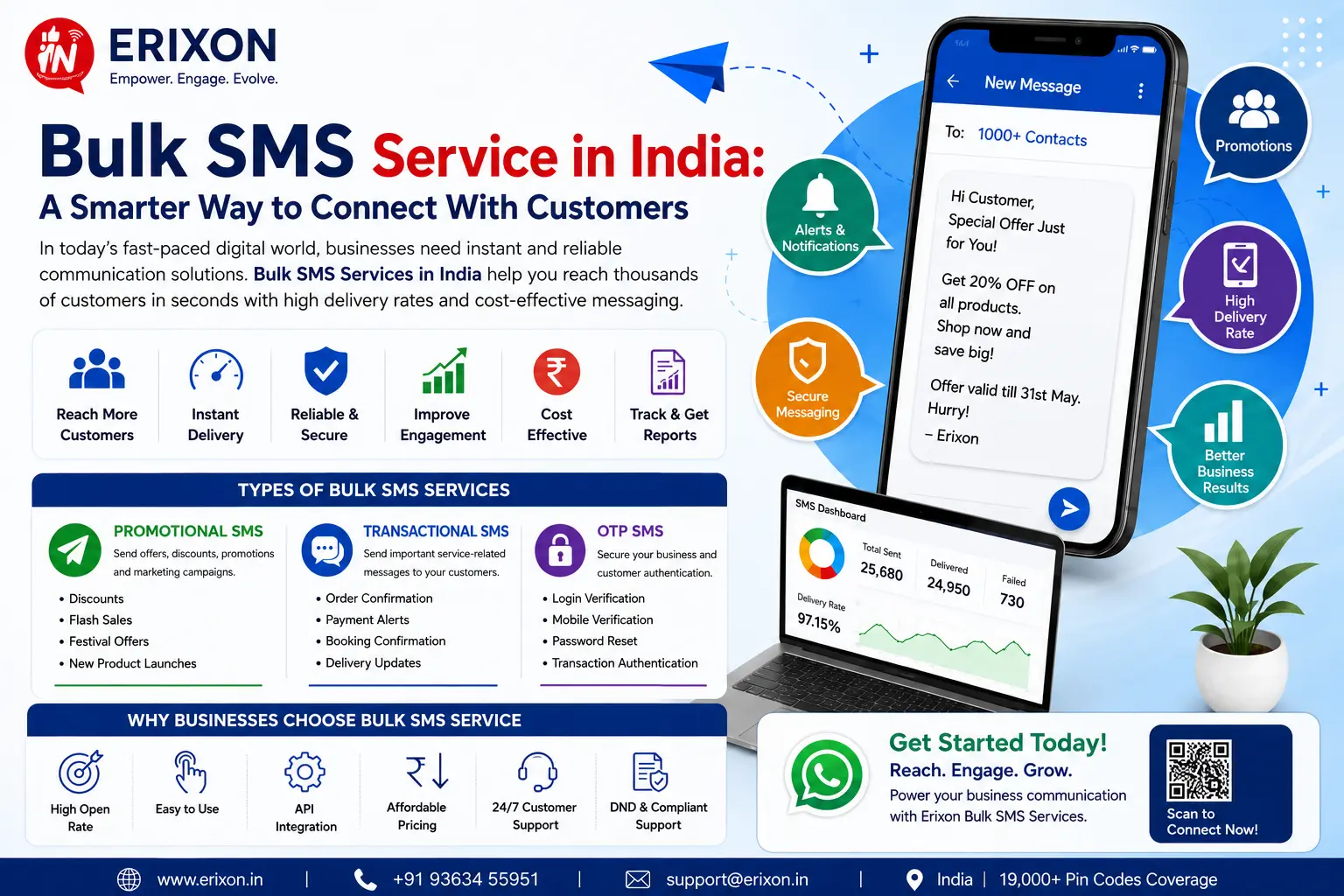
Businesses need a fast and reliable way to communicate with customers. Emails may not be opened immediately, and phone calls are difficult to manage when contacting thousands of people. A Bulk SMS service helps businesses send important information directly to customers’ mobile phones. Companies can use Bulk SMS for promotional campaigns, OTP verification, payment notifications, appointment reminders, delivery updates and other customer communications.
Messages can be sent through an online dashboard or automatically through a Bulk SMS API. Erixon provides Bulk SMS solutions that help Indian businesses manage large-scale customer communication. This guide explains how Bulk SMS works, its different types, business applications, benefits and the important factors to consider when choosing a Bulk SMS service provider.
What Is a Bulk SMS Service?
A Bulk SMS service is a communication solution that allows a business or organisation to send text messages to many mobile numbers simultaneously. Instead of sending each message manually, businesses can upload a contact list, prepare a message and send it to the selected audience through a central platform.
A Bulk SMS service can also be connected to websites, applications, CRM systems and other business software using an API. Businesses commonly use Bulk SMS for:
- Promotional offers
- OTP verification
- Order confirmations
- Payment notifications
- Appointment reminders
- Delivery updates
- Service alerts
- Customer feedback
- Event notifications
- Emergency communication
Bulk SMS can support both marketing communication and essential customer-service messages.
How Does a Bulk SMS Service Work?
A Bulk SMS campaign generally follows these steps:
Prepare or Import Contact List
The business prepares or imports a customer contact list into the central SMS platform.
Segment Audience
The audience is divided into relevant customer groups based on criteria such as purchase history, location, or customer status.
Create the Message
A concise, action-oriented message is created specifically for the selected audience segment.
Select Sender Identity & Approved Template
The appropriate sender identity and approved message template are selected in compliance with applicable DLT regulations.
Schedule or Send Immediately
The campaign is scheduled for an optimal time or sent immediately to recipients.
Network Routing & Message Dispatch
The Bulk SMS platform routes and dispatches the messages across telecom mobile networks directly to customer handsets.
Monitor Campaign Delivery Reports
Real-time delivery reports help the business track delivery rates, monitor responses, and optimize future campaigns.
Businesses can send messages manually through a web-based platform or automate them through API integration. For example:
This process enables businesses to send timely messages without manually handling every customer interaction.
Types of Bulk SMS Services
Different messages have different purposes. Businesses should select the appropriate messaging category based on the nature of their communication and applicable requirements.
Promotional Bulk SMS
Promotional Bulk SMS is generally used to communicate marketing messages and business offers. It can be used for:
- Seasonal discounts
- Festival promotions
- New product announcements
- Special offers
- Store-opening announcements
- Customer loyalty campaigns
- Event promotions
- Limited-time sales
Note: Promotional messages should be sent to an appropriate and consenting audience. Businesses must also follow applicable telecom, DLT and customer-consent requirements.
Transactional & Service SMS
Transactional or service messages provide customers with important information related to an account, purchase or requested service. Common examples include:
- Order confirmations
- Payment alerts
- Shipping notifications
- Delivery updates
- Booking confirmations
- Account notifications
- Service-status updates
- Appointment reminders
Note: These messages are normally connected to a specific customer action or an existing business relationship.
OTP SMS
OTP SMS is used to send one-time passwords for customer authentication and security. Businesses can use OTP messages for:
- Account registration
- Login verification
- Password reset
- Mobile-number verification
- Payment authentication
- Transaction approval
Note: OTP delivery should be fast and dependable because customers usually need to complete an action within a limited period.
Promotional SMS vs Transactional SMS
Understanding the key differences between Promotional and Transactional/Service SMS helps businesses maintain telecom compliance and optimize customer engagement:
| Factor | Promotional SMS | Transactional or Service SMS |
|---|---|---|
| Primary Purpose | Marketing products and offers | Sending important customer information |
| Common Examples | Discounts, seasonal sales, and product promotions | OTPs, payment alerts, and order updates |
| Sending Method | Usually campaign-based | Campaign-based or API-triggered |
| Target Audience | Relevant, consenting audience | Eligible customers or registered users |
| Typical Users | Retailers and marketing teams | Banks, websites, applications and service providers |
Compliance Reminder
Businesses should correctly classify messages and follow the applicable communication regulations, including TRAI guidelines and telecom DLT registration mandates in India.
Benefits of Bulk SMS for Indian Businesses
Bulk SMS remains an indispensable tool for business communication across India due to its universal reach and immediate open rates:
Direct customer communication
SMS delivers information directly to a customer’s mobile device. Customers do not need a special application or active mobile data to receive a standard text message.
Large-scale messaging
A Bulk SMS service allows businesses to communicate with hundreds or thousands of customers through one seamless campaign with a single click.
Fast message delivery
Time-sensitive messages such as OTPs, payment alerts and booking updates can be delivered quickly within seconds through high-priority carrier routes.
Automated notifications
API integration allows messages to be triggered automatically when an event occurs on a website, application or business CRM system.
Personalised messages
Businesses can personalise messages using dynamic variables such as the customer’s name, order number, appointment time or payment status.
Campaign scheduling
Marketing teams can prepare campaigns well in advance and schedule them for dispatch at an optimal date and time for maximum response.
Delivery reporting
Real-time delivery reports help businesses monitor message status, verify successful receipt, and identify delivery issues instantaneously.
Support for different industries
Bulk SMS supports customer communication across e-commerce, healthcare, education, banking, logistics, real estate and other diverse sectors.
Industries That Use Bulk SMS Services
Organizations of all sizes leverage Bulk SMS to enhance their customer journey and operational efficiency:
E-commerce & Retail
Online stores send order confirmations, payment alerts, shipping notifications, delivery updates and promotional offers.
Banking & Finance
Financial organisations use SMS for OTP authentication, transaction alerts, payment reminders and account notifications.
Healthcare
Hospitals and clinics send appointment confirmations, appointment reminders, healthcamp alerts and medical test updates.
Education
Schools, colleges and training institutes use SMS for attendance alerts, examination schedules, fee reminders and event news.
Travel & Hospitality
Travel companies and hotels send booking confirmations, itinerary updates, check-in reminders and seasonal promotional information.
Real Estate
Property businesses share project information, site-visit reminders and follow-up communication with interested buyers.
Logistics
Logistics companies send shipment notifications, tracking updates, out-for-delivery alerts and delivery confirmation messages.
Local Businesses
Restaurants, retailers, salons and service centres use SMS for discount offers, booking reminders and customer relationship updates.
How to Run a Bulk SMS Campaign
Executing an effective Bulk SMS campaign requires careful planning and strategic execution:
Step 1: Define the campaign objective
Decide whether the campaign is intended to generate enquiries, promote an offer, send an alert or update customers.
Step 2: Select the correct audience
Avoid sending every message to every customer. Segment the contact list based on location, purchase history, interests or customer status.
Step 3: Create a concise message
The message should clearly explain: Who is sending it, Why the customer is receiving it, What action the customer should take, and whether the offer has an expiry date.
Step 4: Use an appropriate call to action
Depending on the campaign, the CTA may ask the customer to visit a webpage, contact the business, complete a payment or confirm an appointment.
Step 5: Follow applicable regulations
Use the correct sender identity, approved templates and customer-consent practices as required by applicable Indian telecom and DLT rules.
Step 6: Send or schedule the campaign
Choose an appropriate time and avoid sending unnecessary or excessive messages outside permitted hours.
Step 7: Review delivery reports
Analyse message delivery, click rates, and customer responses to continually improve future campaigns.
Bulk SMS API Integration
A Bulk SMS API connects an SMS platform with a website, mobile application, CRM, billing system or other business software.
An API can automatically trigger messages when:
- A customer creates an account
- An OTP is requested
- An order is placed
- A payment is completed
- An appointment is booked
- A product is shipped
- A delivery is completed
- A payment deadline is approaching
When evaluating a Bulk SMS API, businesses should consider documentation quality, authentication, delivery reporting, error handling and technical support. For more information about automated SMS communication, read our guide to SMS Gateway Solutions for E-commerce Businesses.
How to Choose a Bulk SMS Service Provider
Consider the following factors before selecting a provider in India:
Bulk SMS Pricing Factors in India
Bulk SMS pricing can vary based on several key factors:
- Monthly message volume
- Promotional or service-message category
- Message length (character counts)
- Number of SMS units used per send
- Destination and mobile network
- API requirements
- Dashboard features
- Delivery-reporting requirements
- Technical support level
- Business commitment or package
The lowest price may not always provide the best business value. Delivery reliability, reporting, integration quality and technical support should also be considered. Contact Erixon for pricing based on your expected SMS volume and business requirements.
Bulk SMS and WhatsApp Business API
Bulk SMS and WhatsApp communication can support different parts of a business communication strategy.
SMS is useful for short, direct messages such as OTPs, reminders, alerts and delivery updates that reach all mobile phones without requiring internet access. WhatsApp can support richer customer communication using approved templates, images, documents and interactive experiences.
Businesses frequently use both channels depending on the customer journey and the type of message being delivered. Learn more about Erixon’s WhatsApp Business API solutions.
Why Choose Erixon for Bulk SMS Services?
Erixon helps businesses manage customer communication through Bulk SMS and other cloud communication solutions. Erixon’s communication solutions support:
- Promotional SMS campaigns
- Transactional and service messages
- OTP communication
- Bulk SMS API integration
- SMS gateway solutions
- Delivery reporting
- DLT registration guidance
- WhatsApp Business API
- IVR and voice communication
Whether you need to send marketing campaigns, automated notifications or customer-service updates, Erixon can help you select a communication solution based on your operational requirements.
Frequently Asked Questions
Conclusion
A reliable Bulk SMS service can help businesses send marketing campaigns, OTPs, reminders, alerts and automated customer notifications efficiently. It offers a practical way to communicate with a large audience while reducing manual work. Businesses can improve their SMS communication by selecting the correct message category, segmenting their audience, creating clear messages, integrating business systems through APIs and following applicable communication requirements.
Start Your Bulk SMS Campaign with Erixon
Looking for a reliable Bulk SMS service in India? Connect with Erixon to discuss promotional messaging, transactional alerts, OTP services, Bulk SMS API integration and other business communication requirements.